
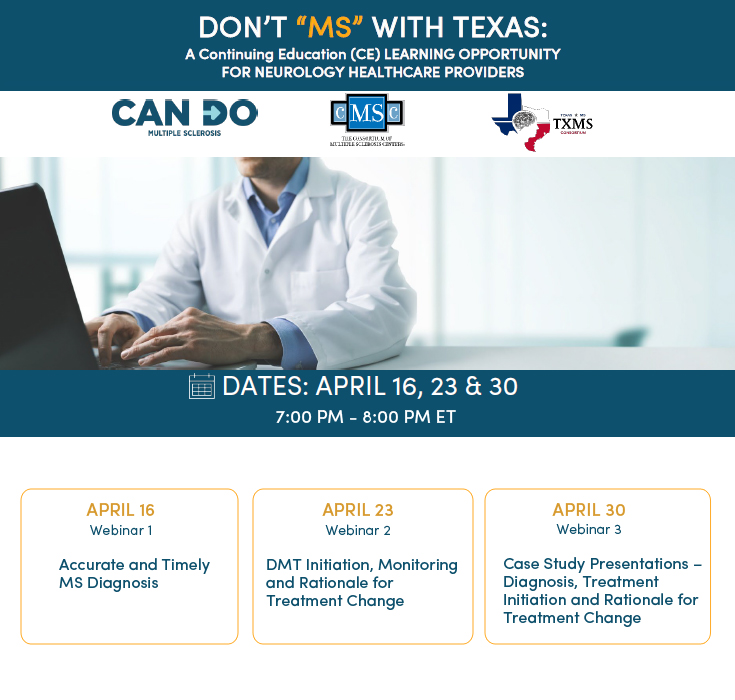
Jointly provided by The Consortium of Multiple Sclerosis Centers (CMSC), The Texas MS Consortium and Can Do Multiple Sclerosis.
We are pleased to share with you a free live virtual CME/CE webinar series offered over three consecutive weeks to help you and your care team apply best practices for diagnosing MS and making treatment decisions. The first two webinars will focus on the clinical application of the latest MS diagnostic criteria, red flags to misdiagnosis, initial DMT choices and determining when a treatment change is needed. The final webinar will present case studies on diagnostic dilemmas and complex treatment decision making.
Target Audience:
The target audience for this activity is physicians, advanced practice clinicians, nursing professionals, mental health professionals, social workers, and other health care providers involved in the management of patients with multiple sclerosis (MS).Learning Objectives:
After completing this program, health care providers will :- Incorporate the 2017 McDonald Diagnostic Criteria into diagnostic strategies in evaluating patients with suspected MS in order to make more accurate and timely MS diagnosis.
- Identify red flags to MS misdiagnosis in order to recognize and address them when evaluating patients.
- Describe how to use a shared decision-making approach for MS DMT decision making.
- Explain factors that indicate a need for a change in DMT.
- Differentiate high efficacy and moderate efficacy MS DMTs in order to better select therapies that address disease characteristics and patient preference – as initial treatment and if a treatment change is needed.
Faculty Lead:
Léorah Freeman MD, PhD,
Dell Medical School at the University of Texas at Austin
Medical Director, MS And Neuroimmunology Center | Assistant Professor of Neurology and Diagnostic Medicine.
Method of Participation / How to Receive Credit
In order to successfully complete this activity, participants must register for the activity, review the required CE information, attend the program, and complete the evaluation form.
To complete the evaluation and claim credit, go to www.highmarksce.com/mscare/
All registrants have an account in HighmarksCE. To retrieve your username/password, click “Forgot Your Password” on the login page and enter the email address you used to register for the meeting. New users will be sent a temporary password and returning users will be sent a link to reset their password.
- Log in with your username and password.
- Once you have successfully signed in, you will be taken to the DASHBOARD page. Navigate to the CREDITS menu and select “Live Activity Credits.”
- Under Claim Credit, choose this activity from the drop-down menu and follow the instructions to receive your credit.
There is no fee to participate in this activity.
Commercial Support Acknowledgment
This activity is supported by independent educational grants from EMD Serono, TG Therapeutics, Inc. and The Kathleen C. Moore Foundation.
Off-Label Disclosure and Disclaimer
This activity may or may not discuss investigational, unapproved, or off-label use of drugs. Learners are advised to consult prescribing information for any products discussed. The information provided in this accredited activity is for continuing education purposes only and is not meant to substitute for the independent clinical judgment of a health care professional relative to diagnostic, treatment, or management options for a specific patient’s medical condition. The opinions expressed in the content are solely those of the individual faculty members and do not reflect those of CMSC or any ineligible company that provided support for this activity.
Contact Information
If you have any questions about this activity, please contact Can Do Multiple Sclerosis at 800-367-1295.